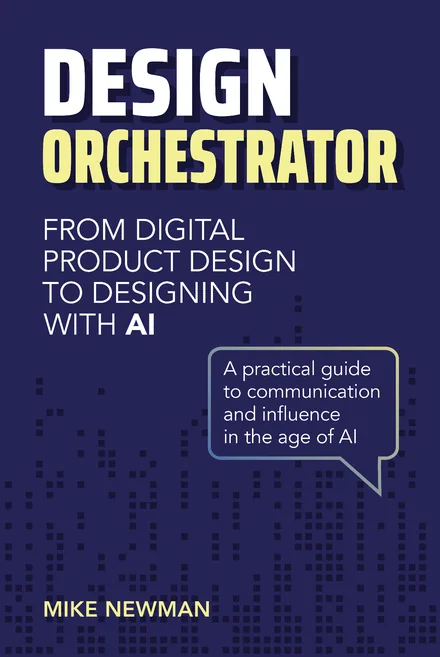
Design Orchestrator
From digital product design to designing with AI
By Mike Newman
- Subject
- AI and the changing role of UX and product designers
- Ideal reader
- UX and product designers, and design leaders, asking what their role becomes as AI takes on more of the production work
- Formats
- Kindle ebook, Paperback, Audiobook
- ASIN
- B0GSK6NZHQ
About the book
Design Orchestrator is a short, practical book about what changes for UX and product designers when AI can produce more of the output. It is not a tools book. It looks at the deeper change happening inside product organisations, and at why the most valuable designers are increasingly defined not by the screens they produce but by their ability to frame problems, guide conversations, and help teams make better decisions.
The argument runs through the book in one line: as production gets easier, direction gets harder, and direction is where design work is moving.
Who it is for
- UX and product designers wondering what their role looks like next
- Senior and staff designers moving closer to decisions and further from artefacts
- Design leads and managers rethinking what their teams are for
- Designers already using AI tools daily who want a clearer view of where their value sits
Problems it helps with
- Not knowing how to describe your value when AI can produce a screen in seconds
- Teams jumping straight to solutions because AI makes finished-looking output cheap
- Design work being treated as production capacity rather than direction
- Feeling busy and fast, but less certain the work is solving the right problem
Key themes
- AI and product design
- AI-assisted design workflows
- The future of UX and product design roles
- Design orchestration
- Human judgement, taste and direction
- Design leadership and influence
- Working with generative AI in product teams
What you will learn
- What a design orchestrator actually does day to day
- How to move from producing artefacts to guiding decisions
- How to use AI tools without handing over ownership of the thinking
- How to protect discovery when the team can build fast
- How to make your contribution legible to product, engineering and leadership
Why the subject matters now
AI tools are compressing the middle of the design process. Drafting, iterating and producing options is faster than it has ever been, which puts more weight on the two ends: understanding the problem properly at the start, and interrogating the output critically at the end.
That is a change in what designers are for, not just in how they work. Design Orchestrator is written from inside that transition rather than about it from a distance.
Frequently asked questions
What is a Design Orchestrator?
A design orchestrator is a designer who works in the space between tools, teams, problems and decisions. Rather than being the person who makes every artefact, the orchestrator helps the team understand what matters, why it matters, and what should happen next — bringing together user needs, product direction, business goals, technical constraints and AI-assisted workflows.
Is Design Orchestrator for UX designers?
Yes. It is written for UX and product designers, and for the design leads who work alongside them. The examples come from digital product work rather than from a general AI audience.
Is Design Orchestrator a book about AI?
It is a book about design in the age of AI rather than a guide to AI tools. Tools change quickly; the book focuses on what happens to the role, the process and the decisions when production is no longer the constraint.
Will AI replace UX designers?
AI is changing how UX designers work rather than replacing the role. It reduces time spent on production and increases the need for framing, context, trade-offs and decision-making. Less time making screens, more time making sense.
What skills will product designers need in the AI era?
Discernment over volume, clear communication over cleverness, facilitation and orchestration over control, and the ability to connect user, business and technical realities. The tools still need learning, but the tools alone are not where the value sits.
Who should read Design Orchestrator?
Designers who are trying to understand where their role goes next and how to stay valuable as the work changes. It is short by design: read it on the weekend, apply it on Monday.
How it relates to the other books
Design Orchestrator carries the communication ideas from Sweet Spot UX into the AI era, and follows on from the career foundations in Kickstart Your UX Career.
- Sweet Spot UX UX communication, stakeholder influence and getting design work understood
- Kickstart Your UX Career Starting and establishing a UX design career
- What is a Design Orchestrator? the concept explained in full
- Read a Chapter 1 excerpt